
Why Your Next Data Engineering Search Might Take Longer Than You Think
For years, “data engineer” was close enough to a single job description. A company needed someone who could move data from one place to another, clean it up, and keep the pipes from breaking. Some SQL. Some Spark. Done.
That job does not exist anymore, at least not the way companies are hiring for it.
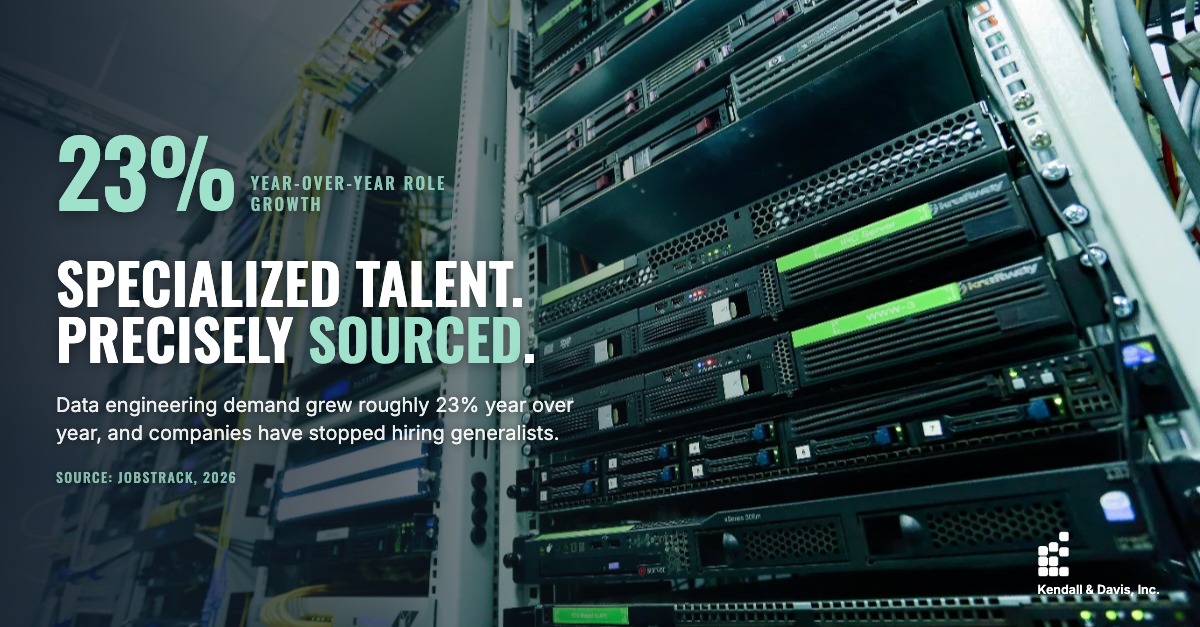
New analysis from Jobstrack put a number on something we have been seeing in searches all year: data engineering demand is up roughly 23 percent year over year. But the growth rate is not the interesting part of that research. What companies are asking for underneath it is.
The generalist is gone
Companies are no longer hiring for someone who knows “some Spark and some SQL,” according to Jobstrack’s 2026 hiring analysis. They want depth in specific architectural patterns. Specific cloud platforms, not “cloud experience” as a category on a resume. And increasingly, working knowledge of compliance frameworks tied to regulations like the EU AI Act, because data engineering decisions now touch AI governance whether a company planned for that or not.
That is a much narrower target than “data engineer” used to describe. A narrower target changes how a search has to run.
Why a job posting is the wrong tool for this
Here is the problem with a narrow, specific requirement: the people who meet it are rarely applying anywhere. They are employed, doing exactly this kind of work, for a company that already figured out how valuable they are.
Posting a job and waiting does not reach that person. It reaches whoever happens to be job hunting the week the post goes live, which is a much smaller and much less specific pool than “everyone qualified to do this job.”
That gap is exactly why proactive outreach matters more than ever in this market. The strongest data engineering candidates are not going to find a posting. Someone has to find them.
It is a tighter squeeze for Midwest companies specifically
This shows up twice as hard for many of our clients. Not only has the role gotten more specific, the pool of people who fit it is being recruited nationally, by companies who do not care whether the candidate relocates. A specialized data engineer in Fort Wayne or Columbus is one remote offer away from working for a company three time zones away.
Regional employers who are still writing job descriptions and sourcing strategies built for 2019 are competing for 2026 talent. That mismatch is a large part of why so many of these searches stall.
What this means if your search has been open a while
If a data engineering seat has been open longer than expected, the Jobstrack data offers a likely explanation. The role has gotten more specific faster than most hiring processes have caught up to. A generic job description pulling from a generic candidate pool was never going to land someone who fits a narrow architectural need.
The fix is not lowering the bar. It is changing how the search runs, from posting and waiting to identifying who already has the specific background and reaching them directly.
If your data engineering roadmap depends on finding that kind of specialized expertise, we would be glad to talk through what a proactive search looks like for your team.
Source: Jobstrack, “How to Get Hired as a Data Engineer in 2026,” https://jobstrack.io/blog/roles/data-engineer (2026)


Leave A Comment